Showing posts with label field trip. Show all posts

Thursday, March 5, 2020

Collection 3 - March 2020, Archbold Biological Station

Lately I've been obsessed...

Obsessed with a habitat which I knew about but until recently didn't realize how little I know about it.  Its the Florida Scrub!

I suppose it all started when I started researching where in Broward County I wanted to buy a house, and I started to look at elevation maps, because I don't want to live in an area that will flood or historically was a swampland, and I found that mostly just eastern Broward was not part of the Everglades. For example, areas like Weston, and parts of Davie, were wetlands, wet grasslands, and cypress swamps. Eastern Broward County, closer to the ocean, is actually higher in elevation, and historically consisted mainly of pine flatwoods and a few areas of scrub habitat. 

Florida scrub habitat is mostly areas that are higher in elevation and consist of mostly well draining sand. They may have been created when sea levels were higher and they may have been a sand dune or island. They support a very unique variety of animals and especially plants, which evolved during these times of higher sea level, when they were cut off from the mainland. So this got me interested in finding a house that may have been in one of these areas, for the practicality of flood avoidance, and also the challenge of gardening with natives here, where many plants are rare or extirpated from Broward already. 

One of the birds that are included in this category is the endemic Florida Scrub-Jay. It used to be found in this county, as well as Miami-Dade, but now they cannot be found in either. They are extirpated, which means locally extinct, and have been since the 1980's (60's for Miami-Dade). 

So as you may have guessed this is what the next collection will be on. The scrub habitat and the only bird that can be found exclusively in this habitat, the Florida Scrub-Jay. Im off to look for the jays and to get inspiration at a scrub stronghold, the Archbold Biological Station in Highlands County. 

I hope when I do find my house I can restore the yard to what a Broward County native scrub would look like.  And can you imagine what would happen if all my neighbors did too?  Maybe the Florida Scrub-Jays could come back to Broward County, and people and jays could live harmoniously...

Anyway, Im off to the Lake Wales Ridge and Archbold Station!

Here is one of the main buildings in front of the visitor center. It's full of native scrub grasses and wildflowers. It is the end of the dry season, but it would be interesting to see when the native wildflower are in bloom. 

One of the many informative signs around Archbold. They do a good job of labeling plants and also having signs explaining a lot of information on the trails. 

A Sand Pine - Pinus clausa and Scrub Hickory - Carya floridana, 
two of the taller trees of the scrub habitat, the hickory is still dormant. 

More view of the habitat, with Scrub Oaks - Quercus sp., Palmettos, 
and Slash Pine - Pinus elliottii in the far back. 

I didn't see any Scrub Jays on my hike at Archbold, but on my way there I did see one sitting on a power line along the highway, so I decided to go back to that area and see if I could get a closer look.
There ended up being a family group of about 15-20 birds. 

Heres a group of 3 Florida Scrub-Jays, Aphelocoma coerulescens. This group was not as tame as a group I've encountered before in Sarasota County, FL.  I didn't notice any were banded. But it's good that they are not exposed to too many people and can live in a more natural state. 


This particular bird was the most visible the whole time. I think it was keeping watch while the other birds were in the scrub below. This area seemed to be a little over grown, maybe it will need a burn sometime soon. 

A watercolor sketch I made of the Florida Scrub-Jay - Aphelocoma coerulescens, at Archbold Biological Station. In my painting, I have a variety of scrub plants from this habitat including:
-Scrub hickory, Carya floridana,  in the back left
-Sand Pine, Pinus clausa in the back right
-Scrub oaks, Quercus geminata and Q. myrtilifolia 
-Rusty Fetterbush, Lyonia ferruginea
-Silver Saw Palmetto, Serenoa repens
-Eastern Pricklypear cactus, Opuntia humifusa 
-Florida Rosemary, Ceratiola ericoides
-Skyblue Lupine, Lupinus diffusus
The blank area is the bright white sand. 

I hope you enjoyed this post, I'll be working on this bird this month, and hopefully on a new garden. This year has been very hectic for sure, and I hope things will calm down. I think being in nature would help a lot for everyone. 


Monday, March 2, 2020

Collection 2 - Feb 2020, Fairchild Tropical Botanic Gardens

Collection 2 - Feb 2020

Location: Fairchild Tropical Botanic Gardens, Coral Gables, Miami-Dade County, FL

134 - Ruby-throated Hummingbird
135 - Palm Warbler, Western ssp.
136 - Gray Catbird

This months collection is inspired by the wonderful and well known Fairchild Tropical Botanic Garden in Coral Gables. These birds are fairly common and easily found at the garden this time of year, where they spend the winter. The idea of the collection was based on birds here in South Florida, that can be seen in residents personal gardens at their homes and in their neighborhoods. Common winter migrants.

Watercolor sketch of the birds and habitat for Collection 2.
134 - Ruby-throated Hummingbird
135 - Palm Warbler, Western ssp.
136 - Gray Catbird

Ruby-throated Hummingbird - Archilochus colubris
flying male, carving 134, with Scarlet Sage - Salvia coccinea.
There was actually a female here, with a flock of American Goldfinches
eating the seeds of the sage.

Ruby-throated Hummingbird - Archilochus colubris
flying male, carving 134, at Fairchild Tropical Botanic Garden.
At this very moment there was a Ruby-throated Hummingbird here.  I feel like this place is the most reliable spot to see a Ruby-throated Hummingbird in the winter in South Florida.

Palm Warbler, Western ssp. - Setophaga palmarum
winter plumage on a grassy base, carving 135
Beggarsticks - Bidens alba, blooming in the lawn.

Palm Warbler, Western ssp. - Setophaga palmarum
winter plumage on a grassy base, carving 135,
at Fairchild Tropical Botanic Gardens, in the lowlands looking up toward the 
Bailey Palm Glade. 

Gray Catbird - Dumetella carolinensis
with Pine-Rockland base, soil, grasses, oak leaves, tiny snail shells,
and the endemic and endangered Small's Milkpea, Galactia smallii,
carving 136, at Fairchild Tropical Botanic Garden in the lowlands amphitheater. 

Pond Cypress Studio - Collection 2

Thanks for visiting my blog, I hope you enjoyed!

Saturday, February 29, 2020

Collection 1 Details, Jonathan Dickinson State Park

Pond Cypress Studio

Collection 1 - Jan 2020

Location and Inspiration: Jonathan Dickinson State Park, Martin Co, FL

130 - Northern Cardinal, Cardinalis cardinalis ssp. floridanus
131 - Bachman's Sparrow, Peuceae aestivalis ssp. aestivalis
132 - Bachman's Sparrow, Peuceae aestivalis ssp. aestivalis
133 - Bachman's Sparrow, Peuceae aestivalis ssp. aestivalis

This collection was a custom made collection for a biologist studying both species. So they will be used in the field and used as decoys. I made them to be as realistic to the subspecies here with size and color, and also so that they are durable and can be used out in the field.

The Bachman's Sparrow carvings were made without feet, their legs are metal.
They can be placed on a snag or branch as shown below. The Northern Cardinal has a base that can be placed on the ground or logs. 

Back details of the Bachman's Sparrow. They're all in a singing position. 

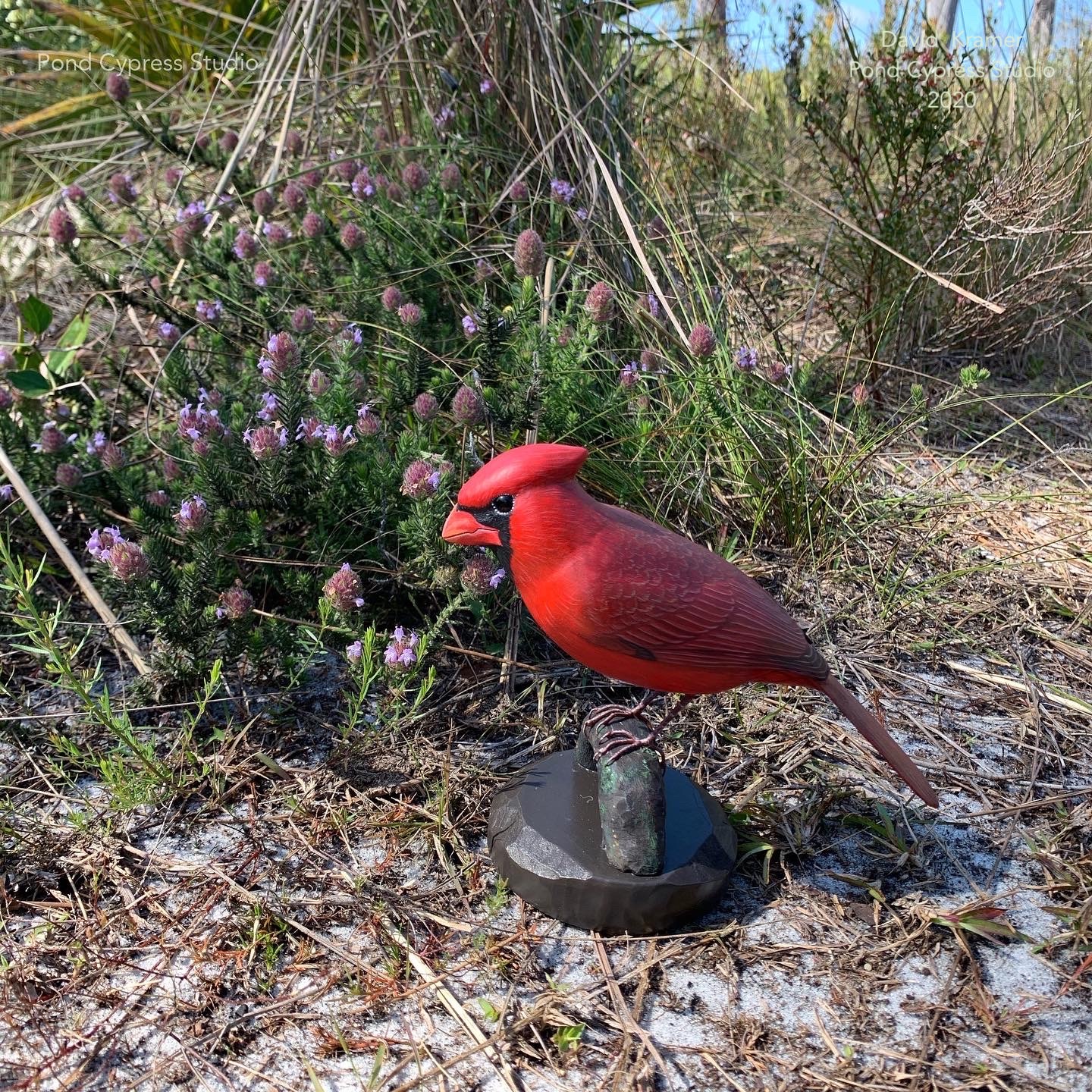
The single male Northern Cardinal.  I made the base to be able to be placed on the ground, and leaves and maybe soil or sand to be placed around it, the little branch or root is covered with small mosses. 


Northern Cardinal, Cardinalis cardinalis ssp. floridanus
Carving #130, out in the field at Jonathan Dickinson State Park. 
It was a really pretty cool winter day. 

Northern Cardinal, Cardinalis cardinalis ssp. floridanus
Carving 130, another shot at Jonathan Dickinson State Park, with a blooming
Netted Pawpaw, Asimina reticulata, behind it. 

Northern Cardinal, Cardinalis cardinalis ssp. floridanus
Carving 130, another shot at Jonathan Dickinson State Park, on the ground
with blooming Wild Pennyroyal,  Piloblephis rigida.

Bachman's Sparrow, Peuceae aestivalis ssp. aestivalis
Carving 131, singing male at Jonathan Dickinson State Park. 
You can see how the wire legs are easily placed on top of a charred pine
to create a realistic position of the bird singing. 


Bachman's Sparrow, Peuceae aestivalis ssp. aestivalis
Carving 131, singing male at Jonathan Dickinson State Park. 
Another view with all the beautiful palmettos and slash pines in the back. 

Bachman's Sparrow, Peuceae aestivalis ssp. aestivalis
Carving 131, singing male at Jonathan Dickinson State Park. 
And another view of the belly. You can see just one of the legs is stuck into the 
charred log. The chest is puffed up, as its singing its loudest, and the mouth is 
actually coated so that it looks wet and shiny. 

I hope you enjoyed this post and this months collection. If you haven't seen the short clip I made for this collection with these photos included please click the link below. Theres some of the blooming wildflowers in that clip as well. 


Sunday, February 2, 2020

Collection 1 - Jan 2020, Jonathan Dickinson State Park

Happy 2020!

This year I'll be introducing something new that I've been wanting to do for a while. I've been thinking and planning and decided I'll make collections of birds every month that will be inspired by a specific location. My January 2020 collection is complete and I took the pieces out into their natural habitat which they were inspired by and photographed them. I also made a short video showing my birds with some scenes during the photo session. Please have a look and I hope you enjoy!


Pond Cypress Studio
Collection 1 - Jan 2020
Location: Martin Co, FL
130 - Northern Cardinal, Cardinalis cardinalis ssp. floridanus
131 - Bachman's Sparrow, Peuceae aestivalis ssp. aestivalis
132 - Bachman's Sparrow, Peuceae aestivalis ssp. aestivalis
133 - Bachman's Sparrow, Peuceae aestivalis ssp. aestivalis

Thursday, December 19, 2019

Northern Cardinal, Carving 127

The Northern Cardinal is one of the most famous birds here in North America, but is also a recognizable bird all over the world, used on household goods and other media, it's a common sight. Here in the US it's found in the eastern portions of the country and the south. It's a common bird in neighborhoods, and a frequent visitor to bird feeders. In Florida we have a subspecies of the Northern Cardinal, sometimes referred to as the Florida Cardinal, Cardinals cardinalis floridans . It's smaller, darker, and has other subtle size and color differences. This one I'm making is somewhat of a prototype.  I have a project to make a decoy for a researcher. It's to help coax males into the mist nest which have been reluctant and shy. We'll see how it goes! 

Northern Cardinal, Cardinals cardinalis floridanus
Finished carving on its unfinished base. It's with a poinsettia in a foo dog planter from Martha Stewart and 1800flowers.com collection from 2007. Its one of my cherished vases!

Northern Cardinal, Cardinals cardinalis floridanus
Finished carving with finished base in a forest setting, with wild 
Bostons fern's growing behind it at Frenchman's Forest Preserve 
in Palm Beach County, FL.

Northern Cardinal, Cardinals cardinalis floridanus
Finished carving among Wild Pennyroyal, Piloblephis rigida,
 it at Frenchman's Forest Preserve in Palm Beach County, FL.

As always, thanks for reading!  I should be having the other cardinal coming out soon.  
Happy Holidays!!

Thursday, November 21, 2019

Warbling White-eye Carving 126

Before traveling to Thailand, we stayed in Japan for very eventful 8 days. 

Japan was amazing, and exceded all my high expectations I had of the country. It was very clean, organized, fun, and just all around very beautiful!

Before the trip I did research on birds to see there, as well as doing research of common or popular birds. Though Japan has a lot of iconic birds such as: the Mandarin Duck, Red-crowned Crane, Japanese Large-billed Crow, and Japanese Pheasants to name a few, I decided to go with a common residential bird: the Warbling White-eye, formally known as the Japanese White-eye. 


While carving I thought that I would make its feet open so I could attach it to any branch and be able to take a picture of it in a natural setting, and thought it would be cool to do it with a nice Japanese temple on the banks of a pond in the background. 

Warbling White-eye, Zosterops japonicus ssp. japonicus, Carving 126
at Fushimi Inari Shrine, in Kyoto, Japan.
You can see its little legs and feet, which are slightly flexible with wire inside. 
This is where I saw the Warbling White-eye, aka, Japanese White-eye, warbling around the 
trees right above the thousands of tourist and visitors walking up the shrine. 

Warbling White-eye, Zosterops japonicus ssp. japonicus, Carving 126

at Fushimi Inari Shrine, in Kyoto, Japan.
Sitting in a sapling Japanese Cedar. This forest around the shrine was 
full of all sorts of birds.  In one spot there was a narrow pond and a Gray Heron in it fishing. 
Some people clapped loudly at it, but Im not really sure why or what the meaning is. 


Warbling White-eye, Zosterops japonicus ssp. japonicus, Carving 126

at Fushimi Inari Shrine, in Kyoto, Japan.
This was along a nicely wooded trail heading up the side of the shrine grounds. 
It was really peaceful here.

Thanks for reading and visiting as always!
David Kramer
Pond Cypress Studio

Saturday, November 9, 2019

Red-necked Stint Carving 125

I recently got back from vacation to Thailand and Japan. It was wonderful and both countries were very unique and interesting. In preparation for the trip I did lots of research on birds that I could look for while there, and I thought of doing a carving for each country.

The first carving I made was for Thailand. I wanted to visit the salt pans south of Bangkok and look for shorebirds. A wide variety of shorebirds can be found here, including the very rare and critically endangered Spoon-billed Sandpiper. I stayed in Bangkok for a few days and did see a lot of new birds, especially by the river and in a fruiting fig tree by my hotel. After that we traveled to Phuket and I did get a chance to be near the beach and look for shorebirds. The first few days I was only able to find Common Sandpipers, and even though I looked in appropriate habitats wasn't able to find any other species. Before going back to Bangkok we stayed in a hotel near Sirinat National Park. It was pretty much a standard tropical beach and I didn't expect to find any shorebirds there. Fortunately at the beach hotel we were staying at there was a coral sandbar that extended from the sandy beach and stuck out into the ocean. During high tide the sandbar, which was actually just massive amounts of broken coral fragments, was cut off from the beach and much smaller. This was perfect because a large flock of about 100+ Lesser Sand-plovers rested here. Among the Sand-plovers I was able to find some a few Common Redshanks, one Ruddy Turnstone, and one Sanderling. Also, very happily, a few Red-necked Stints. I was really worried I wasn't going to be able to find any!

Here's a bunch of Lesser Sand-plovers resting on the coral sandbar. During high tide it seems they would come here to rest until low-tide comes and they travel to exposed areas to feed. Oct 2019.


A close up of one of the Red-necked Stints I saw. They were easy to pick out among the many Sand-plovers because they are constantly moving, and the Sand-plovers were quite still. Oct 2019

Another shot of the Red-necked Stint. Its so tiny and very cute, they're also very active. 
Feeding and running, and then taking off and flying back to the sandbar. They could 
be described as "hyper". Oct 2019


Most of the island is made up of these broken coral branches as well as 
large plate corals and other broken chunks of hard coral. 

My Red-necked Stint - Calidris ruficollis, in the habitat where I saw them. 
This one I painted in the winter plumage with a few worn summer feathers. 
I also made the base to resemble the sand and mud from the salt pans. It has bits of clear/white fine glitter to resemble crystalized salt on the sand. 

Red-necked Stint - Calidris ruficollis,  Carving 125, a view of its back with a single summer feather. 
You can see all the broken pieces of branching corals that the birds feed and peck around during high tide. During low tide I think they travel to the shallow mudflats and river deltas.

Red-necked Stint - Calidris ruficollis, Carving 125. Standing on the coral sandbar. 
All around the sandbar there's a beautiful coral reef, full of coral, fish, and marine invertebrates. 
The water was crystal clear as well and thankfully not too much trash on the beaches here. 

While watching the shorebirds an interesting thing happened. A Peregrine Falcon swooped down on the shorebird flock. They had all taken off just a moment before the falcon got to where the shorebirds were resting. It chased them fiercely and the shorebirds formed a tight and winding flock over the ocean. It was pretty amazing!! The falcon returned back to the island and rested for a moment on a coral boulder. It had failed to catch any of the shorebirds despite its incredible speed! 


Friday, May 31, 2019

Snowy Plover Carving 118, part 1

Its almost summer and its already HOT! A good time to go to the beach and enjoy a day in the sand and water, but of course always be respectful of the wildlife around you, and ones that share the ocean with you. In Florida and many other beaches this means sharing the sand with nesting birds! Like my next carving, the Snowy Plover.

In Florida we have Snowy Plovers year round on our Gulf Coast beaches.  They enjoy the calm waters and white sand found along the gulf. Because of this desirable habitat, to both humans and birds, it also attracts millions of people!! Many of which do not know that the birds here depend on these precise beaches for their lives.  Crowded beaches, pollution, pets, off-road vehicles, have all greatly reduced population of nesting shorebirds and seabirds. This is from nest being destroyed, trampled on, or stressing of the adult birds causing them to abandon their nest. The Snowy Plover is no exception and has become rare and endangered, even locally extinct on some beaches.

On my last birthday I went to Lovers Key State Park in Fort Myers beach to look for some. I had seen on at a nearby beach 2 years before, and wanted to find and photograph more.

It was a windy and rainy day, and I walked the entire length of the beach that faces the gulf and did not see a single Snowy Plover. While walking a Wilsons Plover did land just about 10 feet away from me though; it was quite random but I was happy!

I then went to walk a wooded path and came out to an inlet where the water was much calmer and there was a flock of shorebirds in the distance. I walked toward them along the upper part of the beach, but the flock kept having to go further away as they were being followed by clueless tourist... Eventually the flock flew and came closer to me. The flock was mostly Sanderlings, a few Ruddy Turnstones, and thankfully(!!!) one Snowy Plover.  I was able to get a few okay pictures of it while sitting still on the upper part of the shore, and it even came quite close to me on its own. Eventually, more people came and the plover flew across the inlet and out of sight... Im just thankful I got to see one, and for a moment!

The northern end of Lovers Key State Park. The Snowy Plover is in the picture, but its plumage blends it perfectly into its environment. It just goes to show how it is completely evolved for this area. 


The Snowy Plover, it spotted something tasty!

Another photo of the bird seen today. Its quite camouflage and if it wasn't with the flock of white Sanderling I probably wouldn't have found it!

Im so glad to have found it, but really it's all thanks to the conservationist and volunteers that make a lot of effort to protect these birds.  Without them Im sure I wouldn't have found this one. 

Thanks for stopping by, Part 2 is coming next with carving this charming little bird!

Red-bellied Woodpecker Carving 117

Hello! Sorry I skipped my previous 2 carvings, and my first carvings of 2019.

Carving 115 which I started in December 2018 and finished in January 2019, was a Merlin. I had seen a few during fall migration in Key West and had never done any falcon or hawk carvings before so it was a great learning lesson. It was also such a pleasure seeing these Merlins soaring and stooping over the island, especially the one I saw in a very fast dive over Fort Zachary Taylor State Park!  I think it must have been chasing some Palm Warblers as they were abundant at this time. I will have to make a blog post for it in the future!

Carving 116, is a Least Grebe, I saw on Paradise Island in the Bahamas, in the duck ponds close to the Atlantis Resort. I carved it out hollow so it can float, plus made legs and feet out of bamboo. I was initially going to make it as a kind of toy to play with me niece and nephew at the beach, but it turned out to be a little too nice and a little delicate, so it sits on a plexiglass stand in my room now.

Carving 117 is today's post: Red-bellied Woodpecker

This is the most common woodpecker in South Florida and can easily be spotted around neighborhoods and parking lots planted with scattered trees. It is also common across much of the Eastern United States, with its range expanding north. In South Florida these birds are sometimes considered a subspecies or race: Melanerpes carolinus perplexus. These birds differentiate in having a paler forehead, more black on the tail, the white bars on back larger than black, and smaller in size. Also the South Florida birds eyes are more brown than black. So, I models my carving after this race as these are the birds I see here at home in South Florida.

Red-bellied Woodpecker carving, after its been shaped and sanded, this is the time I do adjusting to the carving and any minor details before painting. 

Red-bellied Woodpecker, being painted at the Palm Beach Gardens studio today. So you can see the back is a little more black than white, the tail is almost entirely black, and the forehead of the male is not entirely red.

Red-bellied Woodpecker finished carving, on a Sabal Palm. The legs and feet are made of wire and wood, and two of the toes create and upside down V so that the bird can hang on a nail, or rough bark of a tree in this case. 

Red-bellied Woodpecker finished carving. These photos were taken at Frenchman's Forest Natural Area, in Palm Beach Gardens. It's a nice local park that has lots of native species.

A side view of the carving. Here you can see how the tail of woodpeckers brace the tree, helping them climb and balance as they peck and hammer at the bark. The tail feathers are strong and stiff! I think if I was to work more on this bird, I would have made him a little slimmer. He's a little too fluffed up for this hot climate. 

A final view of the finished Red-bellied Woodpecker carving, resting on a dead branch of a live oak. 

Thanks for reading! And to see more of my work / process please see my Instagram: @pondcypressstudio


Tuesday, November 20, 2018

Bahama Woodstar Carving 114

Whenever family visits, a great thing to do is thing to do here in South Florida, is to take a cruise!  This is for many reasons: having everyone doing activities together, eating meals together, exploring new places on and off the ship, no cellphone service (so people are more engaged in the moment), and just having fun doing things and making memories!

A secret (or maybe not so secret?) is that birding can be really good when going on cruises!  Even as the ship is going over the ocean in autumn or spring, you can see hundreds of birds migrating, and a lot of birds land on the ship.  I have seen a variety of warblers "fallout" on the ship itself, and even an American Kestrel perched on  a ship flagpole hunting warblers.  ...and this is far from any visible land!  One time while we were on a transatlantic cruise in the spring going from Miami to Funchal (a Portugese Island) we were 2 days already sailing over the open ocean and I was still seeing songbirds flying by! Of course, you do see oceanic birds sometimes, and a few of the birds I've seen are lifers like the Masked Booby and White-tailed Tropicbird, and then some more familiar ones like Royal Terns chasing flying fish and a Red-breasted Merganser speeding by the ship. 

When you finally get to the destination there is, of course, the native species.  Many of the Caribbean Islands have endemic species.  On this trip we stopped at 2 Bahama Islands: Coco Cay (which is Royal Carribean's private island and part of the Berry Island chain) and Nassau. I was on the search for new birds, and to see what kind of birds could be spotted during the short time on the island.  My focus in the Bahamas was the Bahama Woodstar hummingbird!

Me in my beach gear.  There was a cute sign with a Laughing Gull painted on it. 
The Laughing Gull is the most common gull around here and Im glad they painted it, instead of a generic gull. The people didn't heed the sign, and even if they don't feed them directly there is a lot of dropped food anyway!

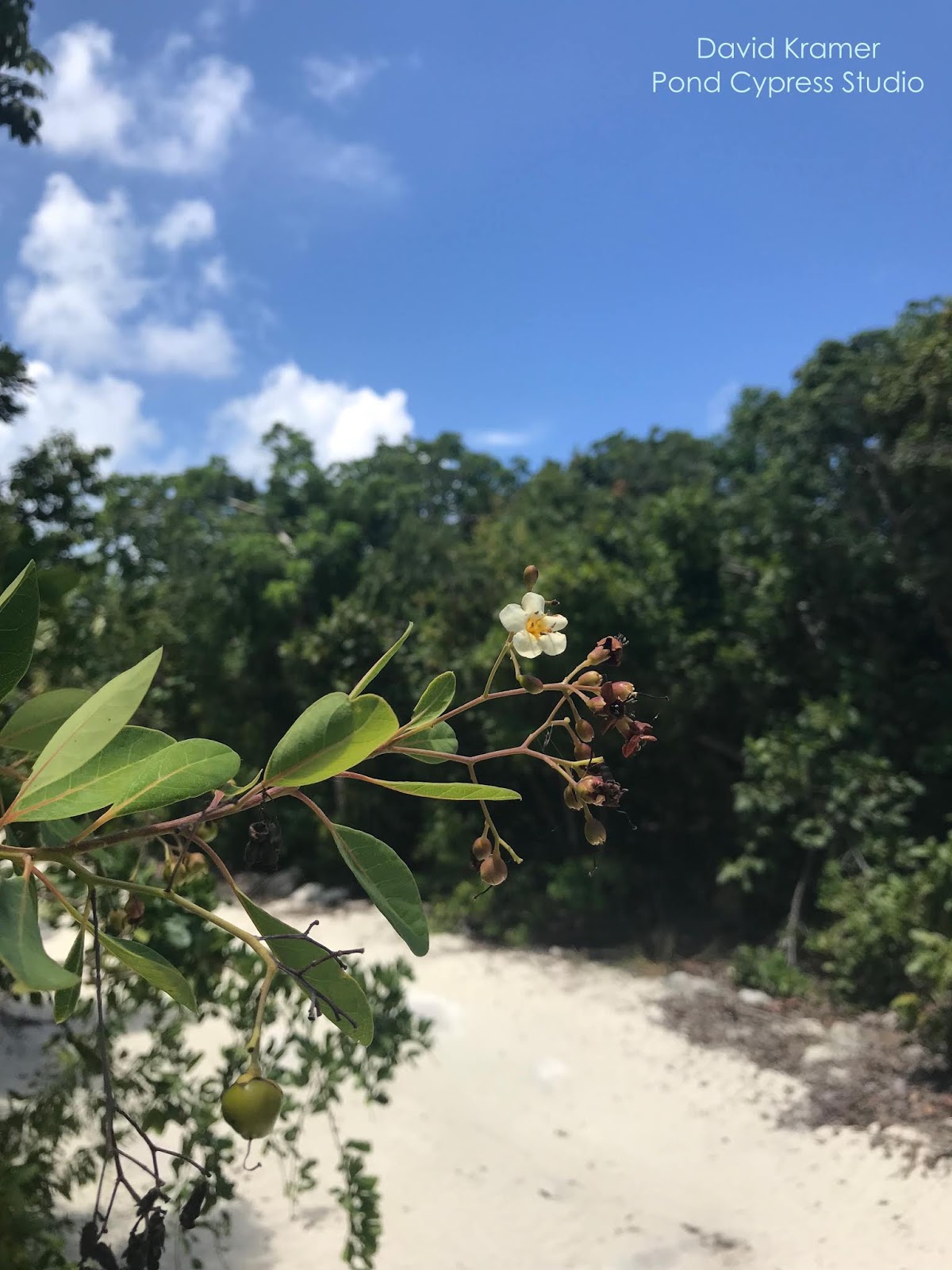
Walking down the beach, away from all the beach parties, and in a quieter area I found a small path. Which had various migratory warblers and some local birds.  I saw lots of Bahama Strongbark trees blooming, and some with lots of pretty red berries. I saw in a shady spot and watched. 

Bahama Strongbark, Bourreria succulenta, blooms and berries.
 I luckily did see a Bahama Woodstar! I didn't get a clear picture of it; and it didn't stop moving for a moment, plus my camera is old and slow to focus. It was visiting each little flower and moved along silently and quickly!

Just a view of the adjacent beach where the little hummingbird was seen. Once I got on the ship that evening, I used my sketches and started making a draft-template of the bird I wanted to carve. 

Fast-forward to my Bahama Woodstar carving. He's sitting on a wood finial that is supposed to resemble the wood of a Bahama Strongbark with the species of lichens found on them. I really like making these carvings because they are the ultimate souvenir for me.  I think of the carving as the actual bird I saw that day. 

Bahama Woodstar
Calliphlox evelynae 
carving number 114
finished Oct. 2018
photographed at Fairchild Tropical Botanical Gardens,
in Coral Gables, FL

Thanks as always for stopping by!

I’m back!

 Hello Readers,  As everyone in the world knows, the last 2 years of the pandemic has been tumultuous and really threw a wrench in everythin...