Friday, May 31, 2019

Snowy Plover Carving 118, part 1

Its almost summer and its already HOT! A good time to go to the beach and enjoy a day in the sand and water, but of course always be respectful of the wildlife around you, and ones that share the ocean with you. In Florida and many other beaches this means sharing the sand with nesting birds! Like my next carving, the Snowy Plover.

In Florida we have Snowy Plovers year round on our Gulf Coast beaches.  They enjoy the calm waters and white sand found along the gulf. Because of this desirable habitat, to both humans and birds, it also attracts millions of people!! Many of which do not know that the birds here depend on these precise beaches for their lives.  Crowded beaches, pollution, pets, off-road vehicles, have all greatly reduced population of nesting shorebirds and seabirds. This is from nest being destroyed, trampled on, or stressing of the adult birds causing them to abandon their nest. The Snowy Plover is no exception and has become rare and endangered, even locally extinct on some beaches.

On my last birthday I went to Lovers Key State Park in Fort Myers beach to look for some. I had seen on at a nearby beach 2 years before, and wanted to find and photograph more.

It was a windy and rainy day, and I walked the entire length of the beach that faces the gulf and did not see a single Snowy Plover. While walking a Wilsons Plover did land just about 10 feet away from me though; it was quite random but I was happy!

I then went to walk a wooded path and came out to an inlet where the water was much calmer and there was a flock of shorebirds in the distance. I walked toward them along the upper part of the beach, but the flock kept having to go further away as they were being followed by clueless tourist... Eventually the flock flew and came closer to me. The flock was mostly Sanderlings, a few Ruddy Turnstones, and thankfully(!!!) one Snowy Plover.  I was able to get a few okay pictures of it while sitting still on the upper part of the shore, and it even came quite close to me on its own. Eventually, more people came and the plover flew across the inlet and out of sight... Im just thankful I got to see one, and for a moment!

The northern end of Lovers Key State Park. The Snowy Plover is in the picture, but its plumage blends it perfectly into its environment. It just goes to show how it is completely evolved for this area. 


The Snowy Plover, it spotted something tasty!

Another photo of the bird seen today. Its quite camouflage and if it wasn't with the flock of white Sanderling I probably wouldn't have found it!

Im so glad to have found it, but really it's all thanks to the conservationist and volunteers that make a lot of effort to protect these birds.  Without them Im sure I wouldn't have found this one. 

Thanks for stopping by, Part 2 is coming next with carving this charming little bird!

Red-bellied Woodpecker Carving 117

Hello! Sorry I skipped my previous 2 carvings, and my first carvings of 2019.

Carving 115 which I started in December 2018 and finished in January 2019, was a Merlin. I had seen a few during fall migration in Key West and had never done any falcon or hawk carvings before so it was a great learning lesson. It was also such a pleasure seeing these Merlins soaring and stooping over the island, especially the one I saw in a very fast dive over Fort Zachary Taylor State Park!  I think it must have been chasing some Palm Warblers as they were abundant at this time. I will have to make a blog post for it in the future!

Carving 116, is a Least Grebe, I saw on Paradise Island in the Bahamas, in the duck ponds close to the Atlantis Resort. I carved it out hollow so it can float, plus made legs and feet out of bamboo. I was initially going to make it as a kind of toy to play with me niece and nephew at the beach, but it turned out to be a little too nice and a little delicate, so it sits on a plexiglass stand in my room now.

Carving 117 is today's post: Red-bellied Woodpecker

This is the most common woodpecker in South Florida and can easily be spotted around neighborhoods and parking lots planted with scattered trees. It is also common across much of the Eastern United States, with its range expanding north. In South Florida these birds are sometimes considered a subspecies or race: Melanerpes carolinus perplexus. These birds differentiate in having a paler forehead, more black on the tail, the white bars on back larger than black, and smaller in size. Also the South Florida birds eyes are more brown than black. So, I models my carving after this race as these are the birds I see here at home in South Florida.

Red-bellied Woodpecker carving, after its been shaped and sanded, this is the time I do adjusting to the carving and any minor details before painting. 

Red-bellied Woodpecker, being painted at the Palm Beach Gardens studio today. So you can see the back is a little more black than white, the tail is almost entirely black, and the forehead of the male is not entirely red.

Red-bellied Woodpecker finished carving, on a Sabal Palm. The legs and feet are made of wire and wood, and two of the toes create and upside down V so that the bird can hang on a nail, or rough bark of a tree in this case. 

Red-bellied Woodpecker finished carving. These photos were taken at Frenchman's Forest Natural Area, in Palm Beach Gardens. It's a nice local park that has lots of native species.

A side view of the carving. Here you can see how the tail of woodpeckers brace the tree, helping them climb and balance as they peck and hammer at the bark. The tail feathers are strong and stiff! I think if I was to work more on this bird, I would have made him a little slimmer. He's a little too fluffed up for this hot climate. 

A final view of the finished Red-bellied Woodpecker carving, resting on a dead branch of a live oak. 

Thanks for reading! And to see more of my work / process please see my Instagram: @pondcypressstudio


Tuesday, November 20, 2018

Bahama Woodstar Carving 114

Whenever family visits, a great thing to do is thing to do here in South Florida, is to take a cruise!  This is for many reasons: having everyone doing activities together, eating meals together, exploring new places on and off the ship, no cellphone service (so people are more engaged in the moment), and just having fun doing things and making memories!

A secret (or maybe not so secret?) is that birding can be really good when going on cruises!  Even as the ship is going over the ocean in autumn or spring, you can see hundreds of birds migrating, and a lot of birds land on the ship.  I have seen a variety of warblers "fallout" on the ship itself, and even an American Kestrel perched on  a ship flagpole hunting warblers.  ...and this is far from any visible land!  One time while we were on a transatlantic cruise in the spring going from Miami to Funchal (a Portugese Island) we were 2 days already sailing over the open ocean and I was still seeing songbirds flying by! Of course, you do see oceanic birds sometimes, and a few of the birds I've seen are lifers like the Masked Booby and White-tailed Tropicbird, and then some more familiar ones like Royal Terns chasing flying fish and a Red-breasted Merganser speeding by the ship. 

When you finally get to the destination there is, of course, the native species.  Many of the Caribbean Islands have endemic species.  On this trip we stopped at 2 Bahama Islands: Coco Cay (which is Royal Carribean's private island and part of the Berry Island chain) and Nassau. I was on the search for new birds, and to see what kind of birds could be spotted during the short time on the island.  My focus in the Bahamas was the Bahama Woodstar hummingbird!

Me in my beach gear.  There was a cute sign with a Laughing Gull painted on it. 
The Laughing Gull is the most common gull around here and Im glad they painted it, instead of a generic gull. The people didn't heed the sign, and even if they don't feed them directly there is a lot of dropped food anyway!

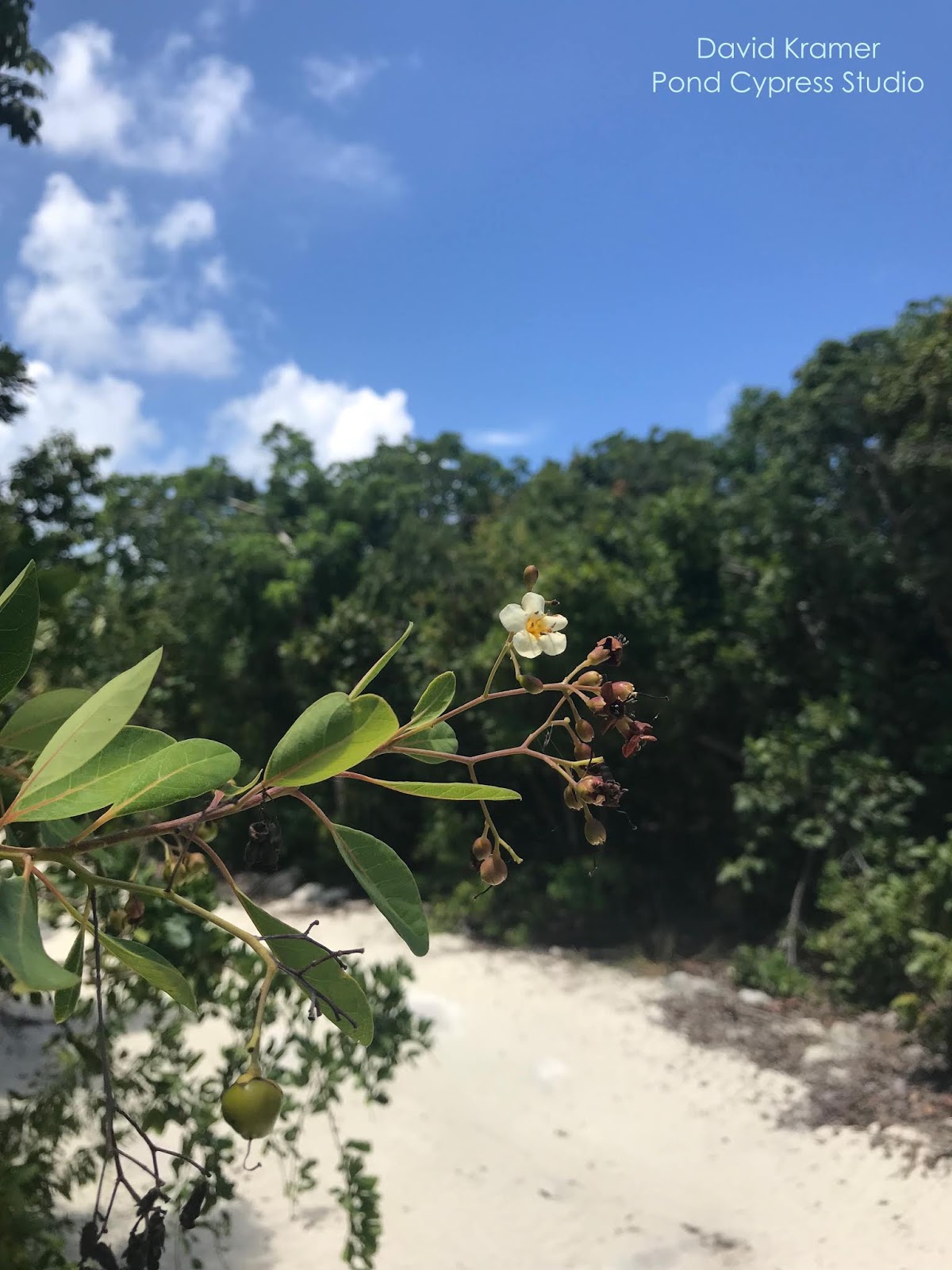
Walking down the beach, away from all the beach parties, and in a quieter area I found a small path. Which had various migratory warblers and some local birds.  I saw lots of Bahama Strongbark trees blooming, and some with lots of pretty red berries. I saw in a shady spot and watched. 

Bahama Strongbark, Bourreria succulenta, blooms and berries.
 I luckily did see a Bahama Woodstar! I didn't get a clear picture of it; and it didn't stop moving for a moment, plus my camera is old and slow to focus. It was visiting each little flower and moved along silently and quickly!

Just a view of the adjacent beach where the little hummingbird was seen. Once I got on the ship that evening, I used my sketches and started making a draft-template of the bird I wanted to carve. 

Fast-forward to my Bahama Woodstar carving. He's sitting on a wood finial that is supposed to resemble the wood of a Bahama Strongbark with the species of lichens found on them. I really like making these carvings because they are the ultimate souvenir for me.  I think of the carving as the actual bird I saw that day. 

Bahama Woodstar
Calliphlox evelynae 
carving number 114
finished Oct. 2018
photographed at Fairchild Tropical Botanical Gardens,
in Coral Gables, FL

Thanks as always for stopping by!

Friday, November 16, 2018

Least Tern Carving 113

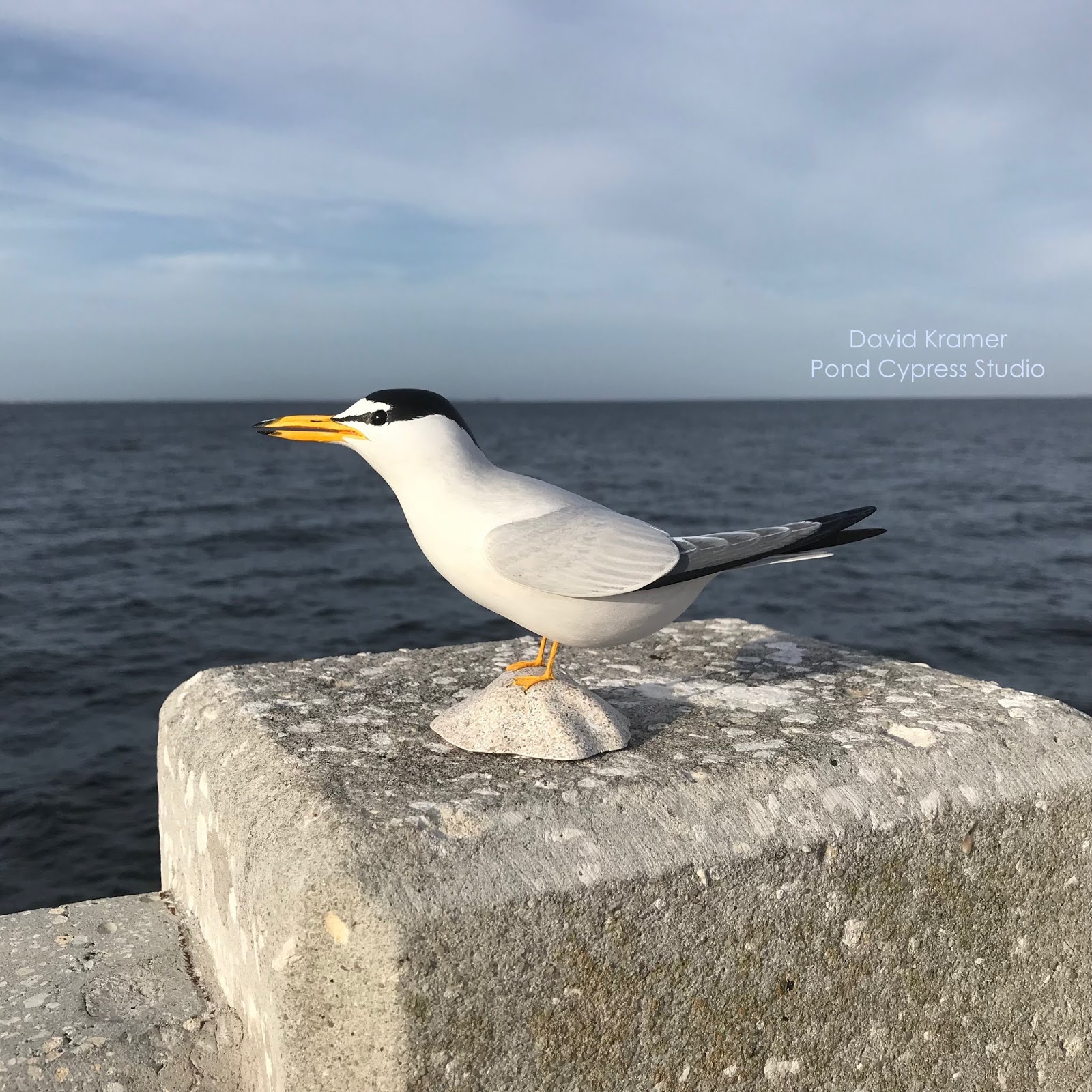
Its mid-fall 2018 now and the holiday season is starting!  Snow birds (actual birds and people from up north) are here in South Florida, and its busy as usual!  There's lots of hustle and bustle here in Broward County with the elections recently, (I Voted!!) and many other changes: large shopping complexes (Dania Point just opened) and work on I-95. Palm Warblers are here, and most of the other Neotropical Migrants have passed through Florida already. The Least Terns have left Florida and are now along the northern coast of South America.  Here is my Least Tern carving, number 113, that I finished in September when the final Least Terns were still here. This is the subspecies Sternula antillarum antillarum, which breeds along the Atlantic Coast of North America.

It's made out of basswood, and painted with acrylic paint. It has black German glass eyes, and metal legs, and sculpted resin feet. The base is also basswood and painted to replicate the sand at Dania Beach, where I saw this particular bird. 

Wing inserts and details of the painting.

Finished Least Tern on the bridge of the South Skyway Fishing Pier, over Tampa Bay. 
Though Least Terns can be seen here they are much less common than Royal and Sandwich Terns, which can be seen in the hundreds some days. 


Least Tern, another view.

Have a safe, happy, and wonderful Holiday Season to all of you readers!
Thanks for stopping by! ~David


Thursday, August 2, 2018

Bachman's Sparrow Carving 112

I finally finished my carving of the Bachman's Sparrow I saw this spring at Jonathan Dickinson State Park, in Martin County, Florida. This carving was carved in my usual style of basswood, and then painted with acrylic paints. I made the legs out of wire and the eye is a german glass eye. I used a naturally charred piece of pine I found as its base and coated it with enamel to prevent any more decay and make it more durable.

A pic from my Instagram @pinecypressstudio showing the beginning stages of painting and preparation of the base.

More progress of the Bachman's Sparrow. This is my 112th bird carving, but only my 4th carving this year. Im trying to carve one bird a month depending on the size and use the addition time after Im finished to make more flat pieces. 

The Bachman's Sparrow is found in open pine woods where it feeds on the seeds of various native species of grasses and insects. Throughout much of its range it relies on wildfires, in the form of prescribed burns, to keeps its habitat open where grasses can flourish. Because of loss of habitat, the Bachman's Sparrow has become uncommon and quite local. 

Bachmans Sparrow
Peucaea aestivalis ssp. aestivalis
Carving 112 - Pond Cypress Studio
David K. Kramer

Saturday, June 9, 2018

Bird Charms!

This year I started to make a variety of carved accessories that I call: bird charms.  These items vary from actual charm, to pendants, keychains, pins, and brooches. I created these out of my own desire for accessories to wear myself and then it grew.

Its been really interesting making these because I've learned a lot while researching and through trial-and-error, of how to design these items.  Each item had its own challenges and I tested the items myself and learned about any flaws they had first hand.  Here are a few I've made so far:

Summer Tanager brooch, holding a berry which is a real ruby.
This bird was actually the second Summer Tanager I made, the first one was just a simple charm but the dimensions of the bill and size of the head needed to be larger. I think its a really unique and charming piece of jewelry. 

Mouring Dove pendant, with a brass ring so it can be worn as a necklace.
The eye is a german glass eye, and painted with acrylic paints.  I use Martha Stewart Craft Paint for all my birds. 

White-eyed Vireo pendant with a custom made glass eye.
This was made with a Prairie Warbler charm, but that piece was sold.

Green Heron keychain or bag charm.
This one had a screw hook attached to the back of the birds head and then attached to the keychain hardware but this is not as secure as I like.  Im currently testing an alternative, which can be seen on the Black-bellied Whistling Duck below. 

A variety of bird charms/pendants:
(from right to left)
Eastern Bluebird, Purple Gallinule, Fish Crow, Barred Owl, Least Tern. 
This photo washed out the color a little bit, the last picture does show more true to color.

Black-bellied Whistling Duck keychain. 
This is the new style I'm testing where a wire goes through a hole in the back of the birds head.
This seems to be a lot more secure, but I do need to find a cleaner way to attached the bird to the ring rather than with just twisted wire (which actually isn't that sturdy).

A group photo of all the charms in this post for size comparison. 
I always try by best to make my birds accurate to their life size.  I research their sizes from data collected through field work, so they are usually down to the millimeter. 

Friday, June 1, 2018

Carolina Wren Carving #8

Yesterday on my Instagram I did a throwback to my 8th bird carving which was done in June of 2010. Its a Carolina Wren that I would see in my backyard when I lived in Houston, TX.  I would hear it sing often, as well as its mate, and sometimes it would sleep tucked under a metal bracket of the back patio.  I put up a small bird house for it in my shade garden full of native grasses and wildflowers, but it never nested there.  I gifted this Carolina Wren to my parents and it sits happily on a shelf in their kitchen with some of my other carvings. I went to visit them for Memorial Day and when there was a break in all the rain, I decided to take some pictures.

This bird was one of the few that have full wire feet; something I would do when I first started carving. After the wire feet phase, I used molded pewter feet but I wasn't really happy with them, especially for the tiny birds like warblers. Currently I have switched back to using wire, but only for the leg (tarsus) portion of the leg.

Carolina Wren, carved in June 2010

Carolina Wren bottom details. On all my birds I sign with my initials DKK and the month/year.  I do record all the exact details in a journal I have that includes where I saw the bird, what it was made of,  and the exact date I finished the bird, plus the name of the person of the person who purchased the bird from me or who I gifted the bird to. 

I’m back!

 Hello Readers,  As everyone in the world knows, the last 2 years of the pandemic has been tumultuous and really threw a wrench in everythin...